M21.L01 — Adverse Selection: The Market for Lemons
Module: Module 21 — Information Asymmetry and Synthesis Lesson: L01 of 05 Duration: ~30 minutes Level: Intermediate Provenance: Intermediate Microeconomics with Excel (Barreto) | MIT OCW 14.01 Principles of Microeconomics
Learning Objective
Key Diagram
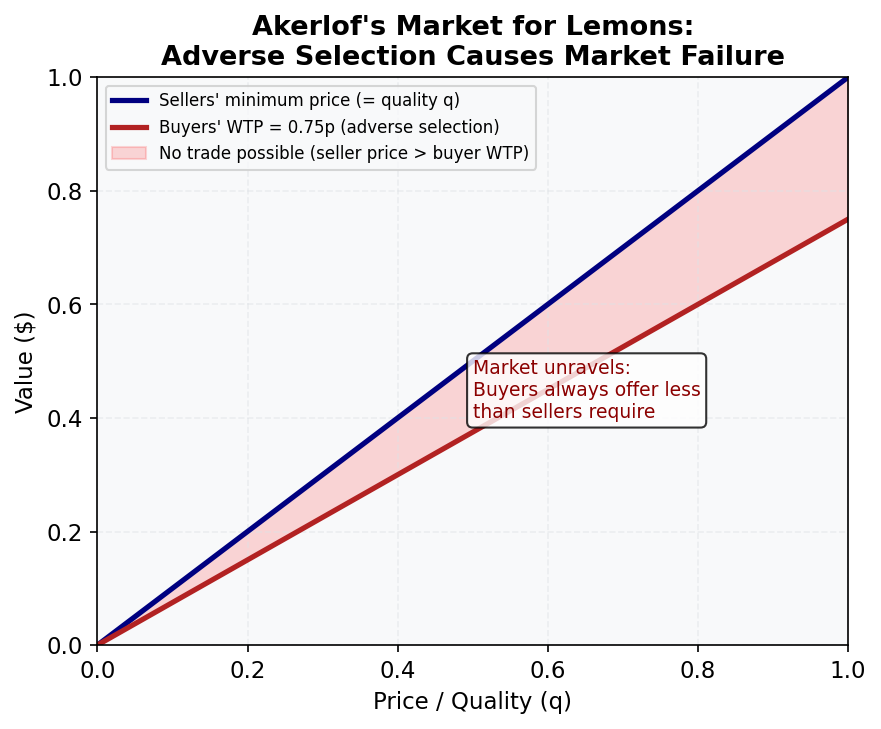
Figure 13: Adverse Selection (Akerlof's Lemons). Buyers always offer less than sellers require — the market unravels completely under information asymmetry.
Explain how asymmetric information leads to market failure in the market for lemons.
The Market for Lemons
George Akerlof's 1970 paper demonstrated how information asymmetry between buyers and sellers can lead to market failure. In the used car market:
- Sellers know the true quality of their cars (peaches vs lemons)
- Buyers cannot observe quality before purchase
- This creates adverse selection where bad products drive out good ones
In Australia, similar dynamics appear in:
- Private health insurance markets (healthy individuals drop out, leaving sicker pool)
- Used car markets (especially for high-value vehicles)
- Credit markets (higher-risk borrowers more likely to seek loans)
Formally, let q represent quality with uniform distribution q~U[0,1]. If buyers can't observe q, they'll only pay average quality E[q] = 0.5. But sellers with q > 0.5 withdraw, lowering average quality to 0.25, and so on until market collapses.
Worked Example
[Australian context]
Consider Australia's private health insurance market with two risk types:
- Low-risk (probability of claim = 0.1)
- High-risk (probability of claim = 0.9)
If insurers can't distinguish types and charge pooled premium P = 0.5, low-risk individuals (expected benefit 0.1) drop out, leaving only high-risk customers. Premiums rise to 0.9, making insurance unaffordable for many.
Common Misconception
"Adverse selection means all bad products enter the market"
Correction: Adverse selection refers to the process where asymmetric information causes market quality to decline, potentially leading to market collapse. It doesn't mean only bad products exist, but that the market becomes dominated by them.
Key Takeaways
- Information asymmetry leads to adverse selection
- Markets may collapse or become inefficient
- Signaling (e.g., warranties) can help mitigate the problem
- Government intervention (e.g., Medicare) may be necessary in severe cases
Practice
- Calculate the market price in a lemons market where quality q~U[0,1] and sellers withdraw if q > p.
- Why might mandatory health insurance (like Australia's Medicare Levy) reduce adverse selection?
- How could used car dealers signal car quality to buyers?
Further Resources
Provenance: Intermediate Microeconomics with Excel (Barreto) | MIT OCW 14.01 Principles of Microeconomics