M06.L02 — Perfect Competition: Characteristics and the Price-Taking Firm
Module: Module 06 — Market Equilibrium and Perfect Competition Lesson: L02 of 05 Duration: ~30 minutes Level: Introductory Provenance: Principles of Microeconomics (Curtis and Irvine) | Khan Academy Microeconomics
Learning Objective
Key Diagram
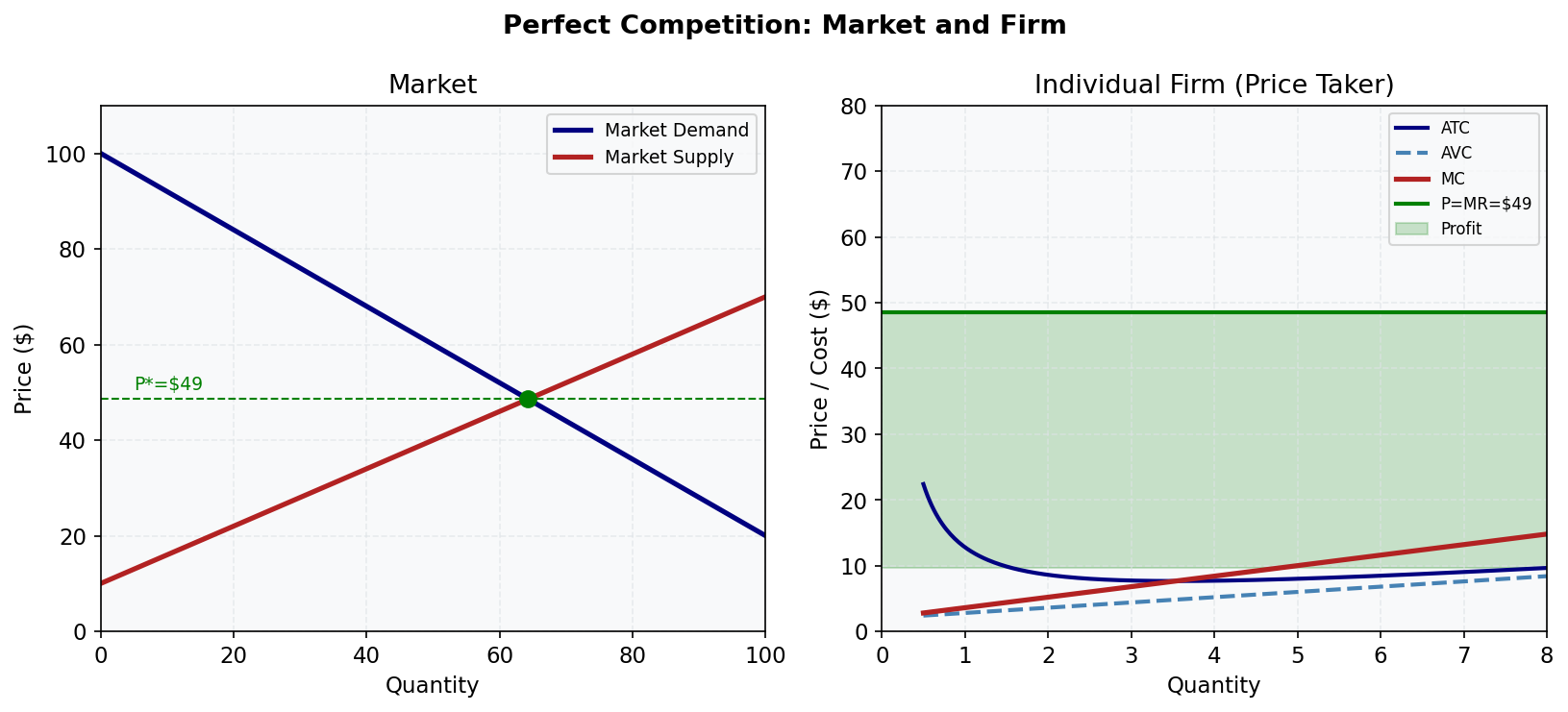
Figure 5: Perfect Competition. The market (left) determines price; the individual firm (right) takes that price as given and produces where MC = P.
Explain the five characteristics that define perfect competition.
The Perfectly Competitive Market
Perfect competition represents an ideal market structure with maximum efficiency. While rare in pure form, some Australian markets approximate these conditions:
- Many small firms: No single producer can influence market price (e.g., wheat farmers)
- Identical products: Commodities where branding doesn't matter (ASX-listed shares)
- Free entry/exit: No significant barriers (agricultural markets)
- Perfect information: All participants know prices and quality (financial markets)
- Price takers: Firms accept the market price (grain prices set globally)
The Firm's Demand Curve
Key distinction: - Market demand: Downward sloping (all consumers) - Firm demand: Perfectly elastic (horizontal) at market price
Why? In perfect competition: - P = AR = MR - If a firm raises price → loses all customers - If lowers price → unnecessary revenue loss
Australian example: Individual dairy farmers take the wholesale milk price set by the market.
Worked Example
ASX Share Trading
- Market characteristics:
- Thousands of buyers/sellers
- Identical shares of the same company
- Real-time price information
-
No barriers to trading
-
Individual trader perspective:
- Must accept current market price
- No quantity restrictions
- Can enter/exit positions instantly
Common Misconception
"Perfect competition means all firms earn zero profit"
In the long run, economic profit tends to zero due to entry/exit. However, firms can earn short-run profits or losses depending on cost structures and market price fluctuations (e.g., seasonal crop prices).
Key Takeaways
- Perfect competition requires five specific conditions
- Firms are price takers facing horizontal demand
- Real-world markets may approximate some features
- Efficiency comes from inability to influence prices
Practice
- Why can't a wheat farmer charge more than the market price?
- How does free entry/exit maintain perfect competition?
- What happens to a firm's demand curve if the market price rises?
Further Resources
- 📺 Perfect Competition Explained — Khan Academy tutorial
- 📚 ASX Education — Real-world price-taking examples
Provenance: Principles of Microeconomics (Curtis and Irvine) | Khan Academy Microeconomics