M04.L03 — Market Equilibrium: Supply, Demand, and Price
Module: Module 04 — Supply and Market Equilibrium Lesson: L03 of 06 Duration: ~30 minutes Level: Introductory Provenance: OpenStax Principles of Microeconomics 3e | MIT OCW 14.01 Principles of Microeconomics
Learning Objective
Key Diagram
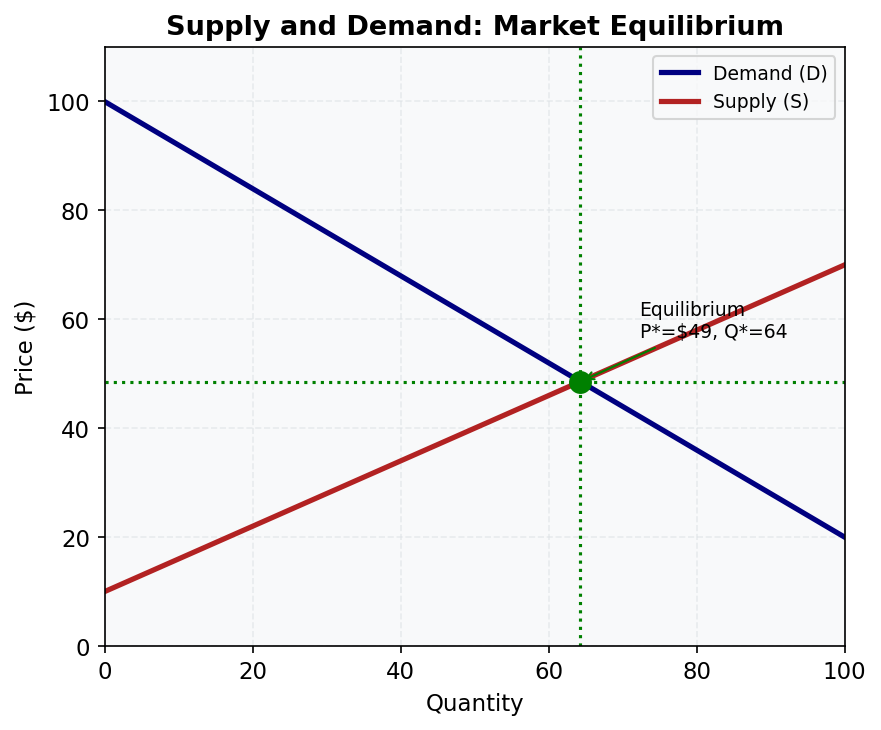
Figure 2: Supply and Demand. The equilibrium price P and quantity Q* occur at the intersection of the supply and demand curves.*
Determine equilibrium price and quantity using supply and demand curves
Finding Equilibrium
Market equilibrium occurs where quantity supplied equals quantity demanded (Qd = Qs). At this intersection point: - There is no tendency for price to change - The market "clears" with no surplus or shortage - Both buyers and sellers are satisfied
In Australia's housing market, equilibrium prices emerge from the interaction of: - Supply: Available properties, construction costs - Demand: Population growth, interest rates, investor activity
Worked Example
Sydney Apartment Market
- Demand function: Qd = 500,000 - 2,000P
- Supply function: Qs = 100,000 + 3,000P
- Set Qd = Qs → 500,000 - 2,000P = 100,000 + 3,000P
- Solve: 400,000 = 5,000P → P* = $80,000 per apartment
- Q* = 100,000 + 3,000(80) = 340,000 apartments
Common Misconception
"Equilibrium means equal numbers of buyers and sellers"
Equilibrium means quantities supplied and demanded are equal at a given price, not that the number of participants is equal.
Key Takeaways
- Equilibrium is the price-quantity combination where markets clear
- Graphical analysis shows the intersection point
- Algebraic solutions provide precise values
- Australian housing demonstrates real-world equilibrium dynamics
Practice
- If demand increases while supply stays constant, what happens to equilibrium?
- How would higher construction costs affect Sydney's apartment equilibrium?
- Why might equilibrium take time to establish in real markets?
Further Resources
- 📺 Market Equilibrium — Khan Academy
- 📚 Australian Housing Market Analysis
Provenance: OpenStax Principles of Microeconomics 3e | MIT OCW 14.01 Principles of Microeconomics