M13.L01 — Budget Constraints: The Consumer's Choice Set
Module: Module 13 — Budget Constraints, Preferences, and Utility Lesson: L01 of 05 Duration: ~30 minutes Level: Intermediate Provenance: Intermediate Microeconomics with Excel (Barreto) | MIT OCW 14.01 Principles of Microeconomics
Learning Objective
Key Diagram
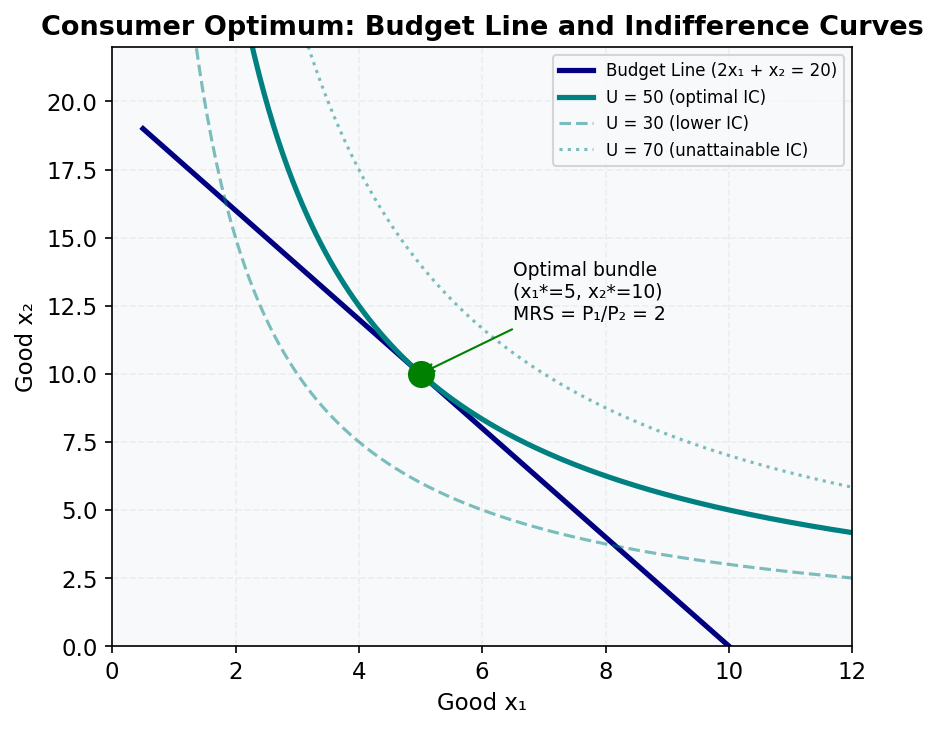
Figure 9: Consumer Optimum. The optimal bundle occurs where the budget line is tangent to the highest attainable indifference curve — the MRS equals the price ratio.
Derive and interpret the budget constraint equation for consumer choice problems.
The Budget Constraint
A consumer with income m faces prices P₁ and P₂ for goods x₁ and x₂ respectively. The budget constraint is:
P₁x₁ + P₂x₂ ≤ m
The budget line (all bundles where the consumer spends exactly their income) is:
P₁x₁ + P₂x₂ = m
Rewriting to show intercepts:
x₂ = (m/P₂) - (P₁/P₂)x₁
- Vertical intercept (x₁=0): m/P₂
- Horizontal intercept (x₂=0): m/P₁
- Slope: -P₁/P₂ (opportunity cost of x₁ in terms of x₂)
Australian Example: Consider a student with \(100 weekly budget for textbooks (P₁=\)50) and coffee (P₂=$5). Maximum textbooks = 2, maximum coffees = 20.
Worked Example
Australian Budget Adjustment
- Original budget: 50x₁ + 5x₂ = 100
- If textbook price rises to $60:
- New intercepts: x₁ = 100/60 ≈ 1.67, x₂ = 20
- New slope: -60/5 = -12 (steeper)
- If income increases to $120:
- New intercepts: x₁ = 120/50 = 2.4, x₂ = 24
- Parallel shift outward
Common Misconception
"A price increase always reduces the maximum quantity of both goods"
Correction: Only the good whose price increased sees reduced maximum quantity. The other good's maximum remains unchanged (though affordable combinations change).
Key Takeaways
- The budget line shows all combinations of goods that exhaust income
- Slope represents the market's tradeoff rate between goods
- Income changes cause parallel shifts
- Price changes rotate the budget line
- The numeraire good simplifies analysis by setting one price to 1
Practice
- Derive the budget line equation when P₁=10, P₂=4, m=200
- How does the budget set change if P₂ increases to 5?
- Calculate the new intercepts if income rises by 20% with original prices
Further Resources
- 📺 Budget Constraints Explained — University of Sydney
- 📚 Varian Ch.2: Budget Constraint
Provenance: Intermediate Microeconomics with Excel (Barreto) | MIT OCW 14.01 Principles of Microeconomics