M20.L06 — Oligopoly Models: Cournot and Bertrand Competition
Module: Module 20 — Monopoly and Game Theory (Advanced) Lesson: L06 of 06 Duration: ~30 minutes Level: Intermediate Provenance: Principles of Microeconomics (Curtis and Irvine) | University of Utah Intermediate Microeconomics
Learning Objective
Key Diagram
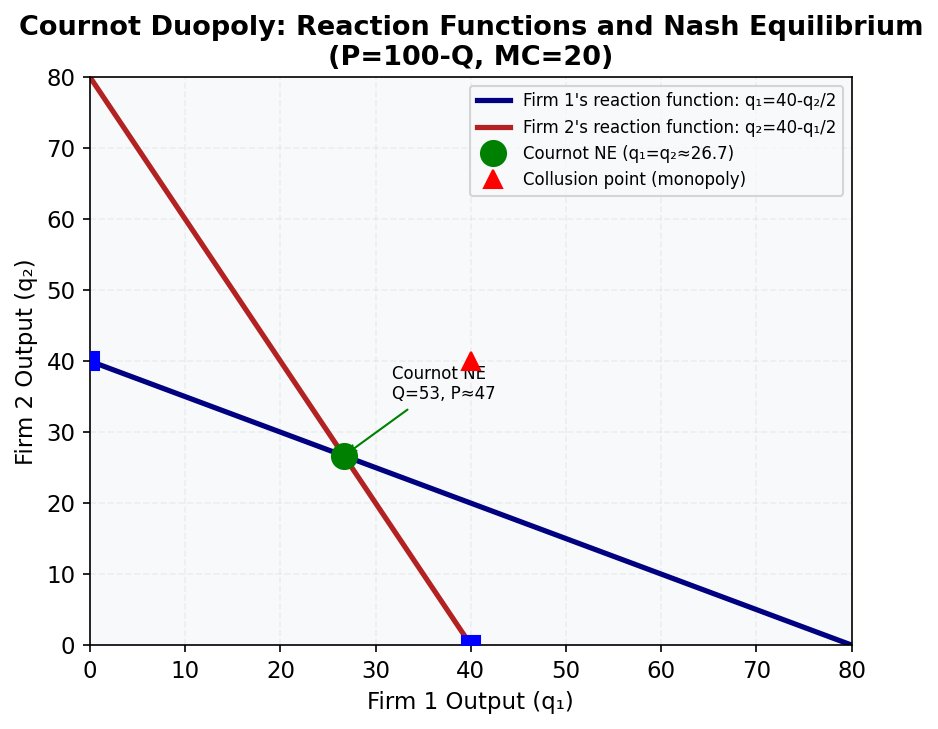
Figure 14: Cournot Duopoly. The Nash equilibrium is at the intersection of reaction functions (Q≈53, P≈47) — between the monopoly (collusion) and competitive outcomes.
Compare Cournot and Bertrand equilibrium outcomes using reaction functions.
Cournot Model
Firms simultaneously choose quantities. Market clearing price P(Q) where Q = q₁ + q₂.
Firm 1's problem: max π₁ = P(q₁ + q₂)q₁ - C(q₁)
Australian example: Woolworths (W) and Coles (C) with P = 100 - Q, MC=10:
W's reaction: q_W = (100 - q_C - 10)/2 = 45 - 0.5q_C C's reaction: q_C = 45 - 0.5q_W
NE: q_W = q_C = 30 → P = $40
Bertrand Paradox
With homogeneous goods and MC₁ = MC₂ = c, P₁ = P₂ = c in equilibrium (competitive outcome).
Australian example: Petrol stations in Sydney undercut until P=MC ($1.50/L).
Worked Example
[Australian context]
Two Australian airlines (Qantas, Virgin) compete:
Case 1: Cournot with P=200-Q, MC=80 Case 2: Bertrand with differentiated products: q_Q = 200 - 2p_Q + p_V q_V = 200 - 2p_V + p_Q MC=80
Find both equilibria.
Solution: 1. Cournot: q* = (200-80)/3 = 40 each, P=120 2. Bertrand: Solve reaction functions p_Q = (200 + p_V + 160)/4 etc → p_Q=p_V=120
Common Misconception
"More competitors always reduce prices"
With capacity constraints or product differentiation, prices may remain above MC even with many firms.
Key Takeaways
- Cournot firms compete on quantities
- Bertrand firms compete on prices
- Product differentiation softens price competition
- Hotelling model explains spatial differentiation
Practice
- Solve Cournot duopoly with P=80-Q, MC₁=10, MC₂=20
- Explain why Bertrand with capacity constraints resembles Cournot
- Find Hotelling equilibrium with transport cost t=2
Further Resources
Provenance: Curtis and Irvine | Utah Economics