Lesson M05.L01: Fiscal Policy: Government Spending and Taxes
Module: Fiscal Policy, Money, Prices, and the Reserve Bank Level: intro Duration: 30 minutes Learning Objective: Define fiscal policy and distinguish discretionary from automatic fiscal policy using Australian federal budget categories. Data as of: 2024 Provenance: RBA Education | OpenStax Macro 3e
Explanation
Key Diagram
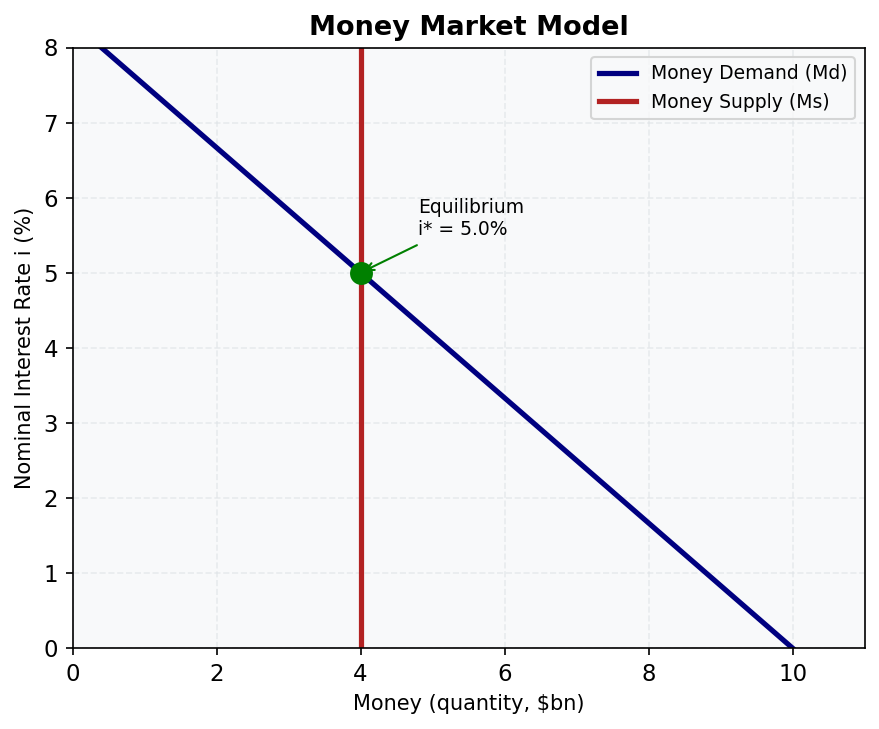
Figure 3: The Money Market. A vertical money supply and downward-sloping money demand determine the equilibrium interest rate.
Fiscal policy refers to the decisions a government makes about how much to spend and how much to collect in taxes, with the goal of influencing the overall level of economic activity. In Australia, fiscal policy is set by the federal government through the Commonwealth Budget, delivered each year by the Treasurer.
There are two broad types of fiscal policy. Discretionary fiscal policy involves deliberate decisions by government — for example, the 2020 JobKeeper wage subsidy program, which was a conscious choice to spend around $90 billion AUD to support workers during the COVID-19 pandemic. Automatic stabilisers are built-in features of the budget that respond automatically to the state of the economy without any new decisions being made. In Australia, the two main automatic stabilisers are:
- Income tax — when the economy slows and incomes fall, the government automatically collects less tax, leaving more money in households' pockets.
- Unemployment benefits (JobSeeker) — when people lose jobs, government spending on JobSeeker payments rises automatically.
The government budget constraint describes the simple accounting identity: if the government spends more than it collects (a budget deficit), it must borrow the difference by issuing bonds. If it collects more than it spends (a budget surplus), it can pay down debt. The Australian federal budget classifies spending as either payments (welfare, health, education) or capital expenditure, and revenue as taxation receipts and non-tax revenue.
Worked Example
Scenario: In a simplified year, the Australian federal government collects $600 billion in tax revenue. It spends $650 billion — $400 billion on social welfare and services (discretionary and automatic), and $250 billion on other government functions.
Step 1 – Calculate the budget balance: Budget balance = Revenue − Expenditure Budget balance = $600bn − \(650bn = **−\)50bn**
A negative result means a deficit of $50 billion.
Step 2 – Identify which spending is automatic vs discretionary: - Unemployment benefits that rose because unemployment increased → Automatic stabiliser (no new law needed) - A new infrastructure stimulus package announced in the Budget → Discretionary fiscal policy
Step 3 – Apply the government budget constraint: The government must borrow $50 billion, typically by issuing Commonwealth Government Securities (bonds) purchased by financial markets.
Conclusion: The $50bn deficit is financed by new borrowing. This is a real-world scenario consistent with Australia's 2020–21 Budget, where the deficit reached approximately $134bn due to COVID-19 spending.
Common Misconception
Misconception: "Automatic stabilisers are a type of government stimulus — politicians decide to activate them."
Correction: Automatic stabilisers require no political decision. They are built into the tax and welfare system by design. When incomes fall, tax revenue automatically falls and welfare payments automatically rise — this happens without any new legislation or ministerial announcement. Only discretionary measures (like JobKeeper) require an active government decision.
Practice Prompts
-
The Australian government announces a one-off cash payment to all households during a recession. Is this discretionary fiscal policy or an automatic stabiliser? → Answer: Discretionary fiscal policy — it required a deliberate government decision and new legislation to enact.
-
During a boom, income tax revenues rise without any change in tax rates. What type of fiscal mechanism is this? → Answer: An automatic stabiliser — higher incomes push more people into higher tax brackets, automatically increasing government revenue and dampening the boom.
-
If the federal government collects $550bn in revenue and spends $610bn, what is the budget balance, and how is the shortfall typically financed? → Answer: Budget balance = $550bn − \(610bn = −\)60bn (a deficit of $60 billion). The shortfall is financed by issuing government bonds (Commonwealth Government Securities).
Further Resources
- 📺 Fiscal Policy and Stimulus: Crash Course Economics #8 — Crash Course (12 min)
- 📺 Macro Unit 3 Summary - Aggregate Demand/Supply and Fiscal Policy — ACDC Economics (15 min)
- 📚 RBA — Fiscal Policy Explainer — How fiscal policy works alongside monetary policy in Australia's macroeconomic framework